GaussIQ is an AI-driven operations platform focused on improving how customer support organizations route and resolve cases.
Support teams rely on constantly evolving expertise, but most organizations still track skills manually in spreadsheets that quickly become outdated, incomplete, or ignored altogether.
As a result, cases are frequently transferred between multiple engineers before reaching the right person. This creates customer frustration, slower resolution times, and unnecessary operational cost.
GaussIQ was built around a central idea: routing work based on continuously evolving skills rather than static queues or team assignments.
I joined GaussIQ as the founding designer. My role extended beyond interface design into product definition—helping translate early ideas and white papers into a coherent product direction.
Discover
Understanding Support Operations
To better understand the operational challenges behind support routing, I led the early discovery and research process for the product.
This included:
Developing research questions and interview frameworks
Conducting stakeholder and user interviews
Analyzing operational workflows and support tooling
Synthesizing recurring patterns across organizations
I interviewed:
Support directors
Line managers
Technical support engineers
Product and engineering stakeholders
While workflows varied between organizations, several patterns emerged consistently.
Support teams were operating in highly complex environments with:
Constantly shifting technologies
Specialized areas of expertise
Large volumes of incoming cases
Pressure to resolve issues quickly while minimizing escalations
Despite having extensive dashboards and reporting systems, many teams still relied heavily on tribal knowledge and manually maintained spreadsheets to understand who had expertise in specific areas.
Routing decisions were often influenced by:
Historical assignments
Queue ownership
Team structure
Individual manager knowledge
Rather than actual, continuously validated skill data.
This created a disconnect between how organizations believed work was being routed and how routing decisions actually happened in practice.
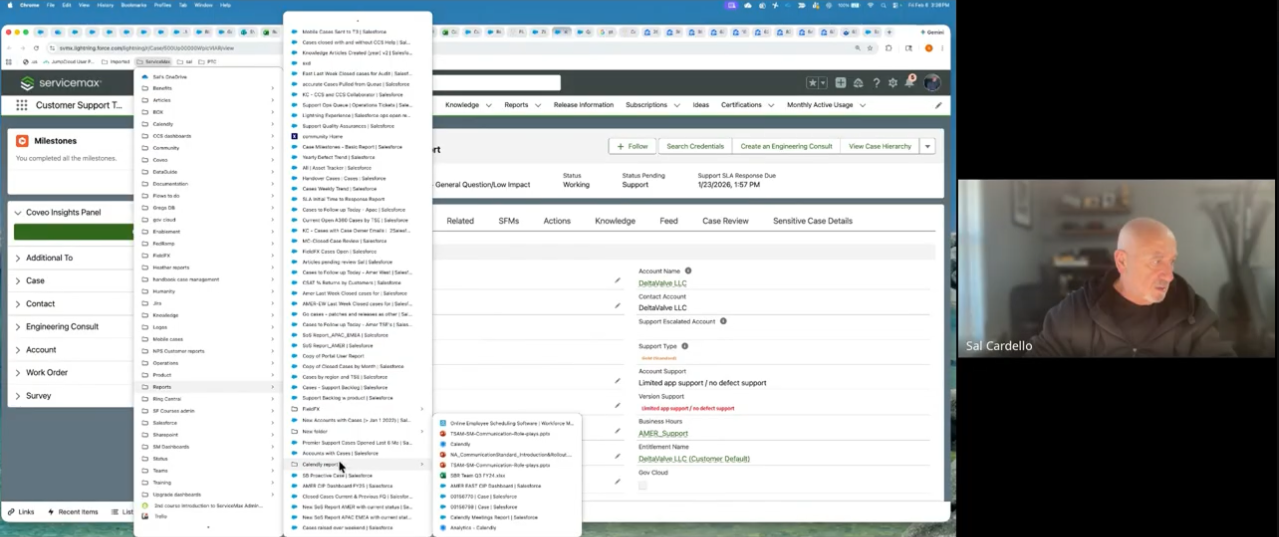
“The last thing I need is another dashboard.”
Contextual interview with Sal - Support Director at PTC, a GaussIQ design partner
Define
Reframing the Problem
Early on, it became clear that the challenge wasn’t simply improving routing accuracy.
Routing failures were symptoms of a broader operational problem: support organizations lacked a reliable understanding of who knew what.
Most teams relied on static organizational structures, historical assignments, and manually maintained spreadsheets to route highly specialized work. As technologies and ownership evolved, these systems quickly became outdated.
This created several downstream problems:
Cases transferred between multiple engineers
Unnecessary escalations
Limited trust in routing decisions
Operational dashboards with little actionable insight
Through stakeholder conversations and workflow analysis, we reframed the challenge around a central question:
“How might we continuously understand and apply organizational skills in a way that improves routing, builds trust, and adapts over time?”
Rather than designing a single feature, the goal became designing a system.
Explore
Exploring Product Directions
As the problem space became clearer, we shifted focus from improving individual routing decisions to designing a broader operational system.
My early explorations focused on operational visibility, routing transparency, and treating organizational skills as a continuously evolving system.
From Dashboard to Control Center
Support organizations already relied heavily on dashboards and reporting tools. Adding another passive dashboard would increase visibility, but not necessarily improve decision-making.
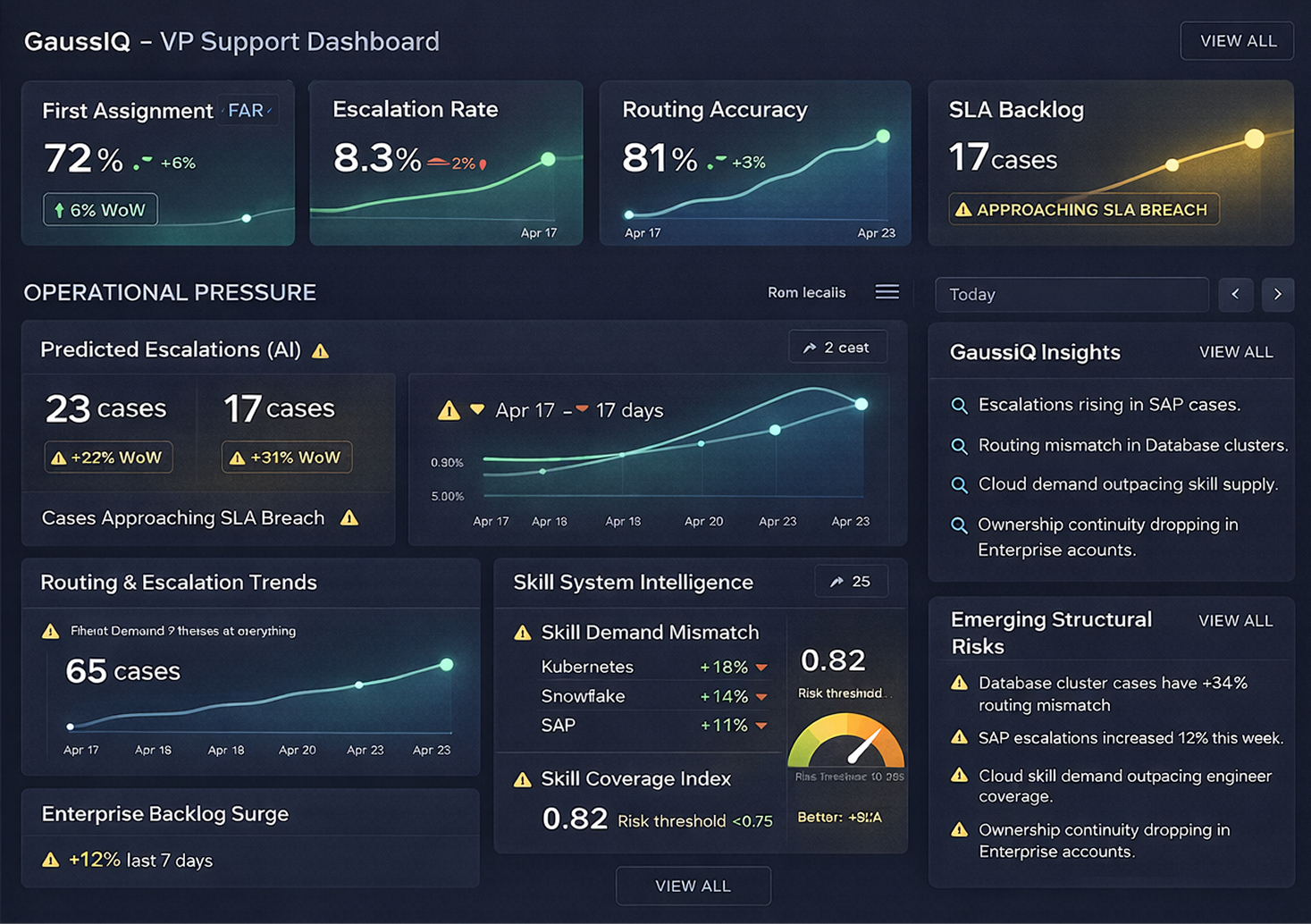
Instead, I steered the product toward the idea of a control center—a system focused on surfacing meaningful operational signals, highlighting emerging problems, and recommending actions before issues escalated.
This led me to explore:
Signal prioritization
Routing health indicators
Recommended actions
Forecasting operational risk
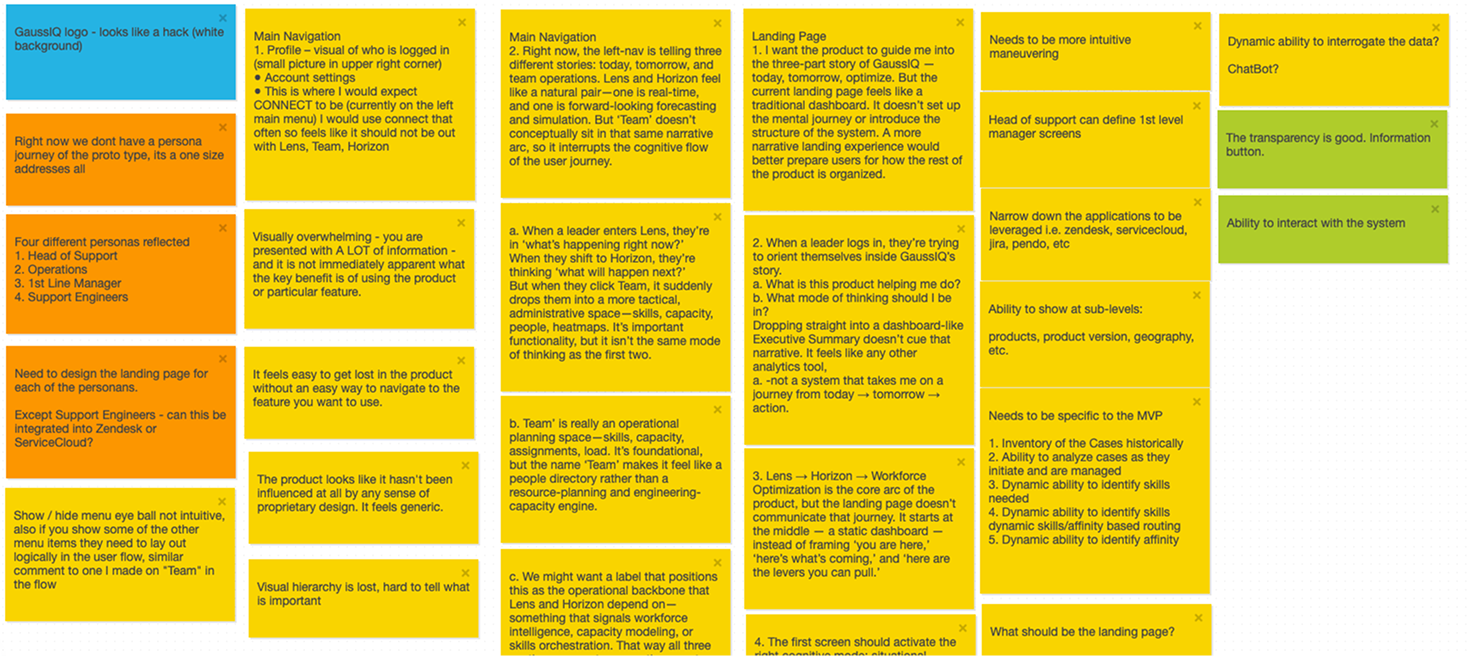
Ideation workshop with GaussIQ leadership
Designing for Explainability
My discovery research revealed that trust was one of the biggest challenges with routing systems.
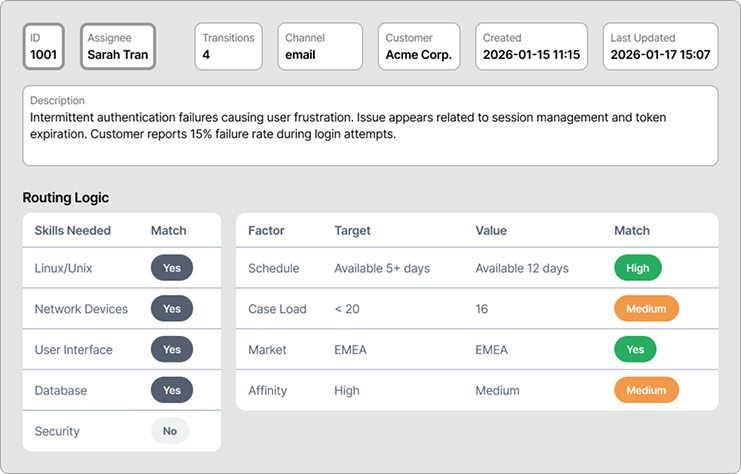
Early wireframe exploration for exposing case routing logic
When cases were assigned incorrectly, teams often had little visibility into why a routing decision had been made. Improving accuracy alone wasn’t enough—the system also needed to explain its reasoning in a way that felt understandable and actionable.
To address this, I explored interfaces that surfaced:
Skill matches
Supporting evidence from case data
Routing confidence indicators
Feedback loops for correcting mistakes
My goal was to make AI-assisted routing feel collaborative rather than opaque.
Skills as a Living System
A major insight from the discovery process was that organizational skills are constantly evolving.
New technologies emerge, product ownership shifts, and expertise changes over time. Static spreadsheets could not keep pace with this reality.
This led me to think about treating skills as a living system—one that could continuously identify, validate, and refine expertise across the organization.
My explorations included:
Skill discovery workflows
Approval and validation systems
Skill coverage views
Emerging expertise signals
Early wireframe exploration of skill tracking for support engineers
These explorations helped establish the foundation for the MVP direction: a system focused not just on routing work, but on continuously understanding the organization itself.
Design
Designing the System
With the core product direction established, my focus shifted toward designing the operational systems that would support skills-based routing at scale.
Rather than treating routing as a single interaction, I designed the product as a connected ecosystem of signals, feedback loops, and continuously evolving organizational knowledge.
My design work centered around four major areas:
Operational visibility
Routing explainability
Skills intelligence
Design systems & scalability
Operational Visibility
One of the primary design challenges was determining how operational issues should be surfaced to leaders without overwhelming them with noise.
My early concepts explored traditional dashboard patterns, but these approaches often emphasized passive monitoring over actionable insight.
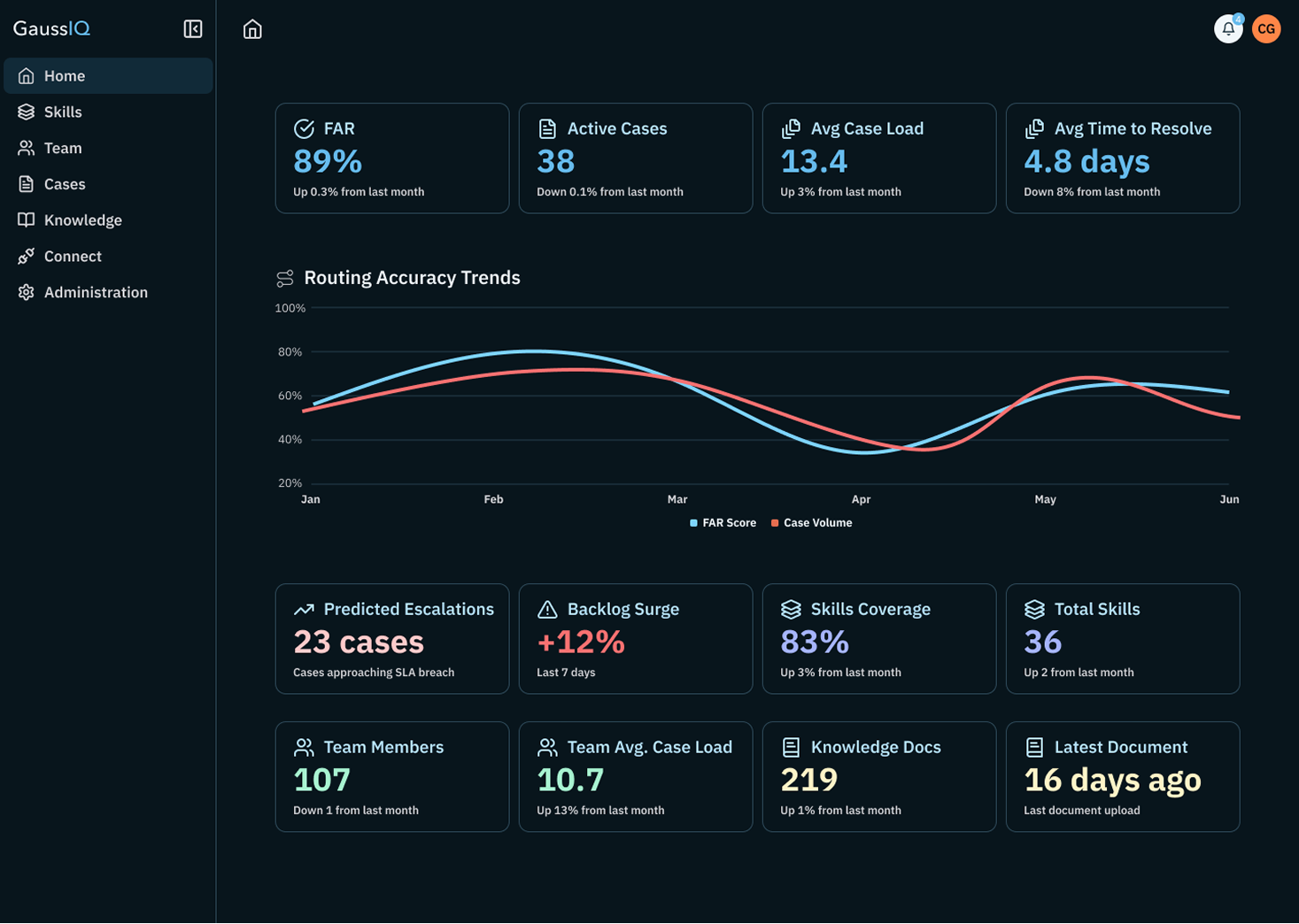
The final direction focused on surfacing:
Emerging operational risks
Routing model health
Coverage gaps across skill areas
Recommended actions tied to specific issues
This shifted the experience away from static reporting and toward a more proactive operational control center.
AI generated exploration of the GaussIQ landing page
Routing Explainability
Trust became a central theme throughout the design process.
Support organizations needed more than accurate routing—they needed confidence in why decisions were being made.
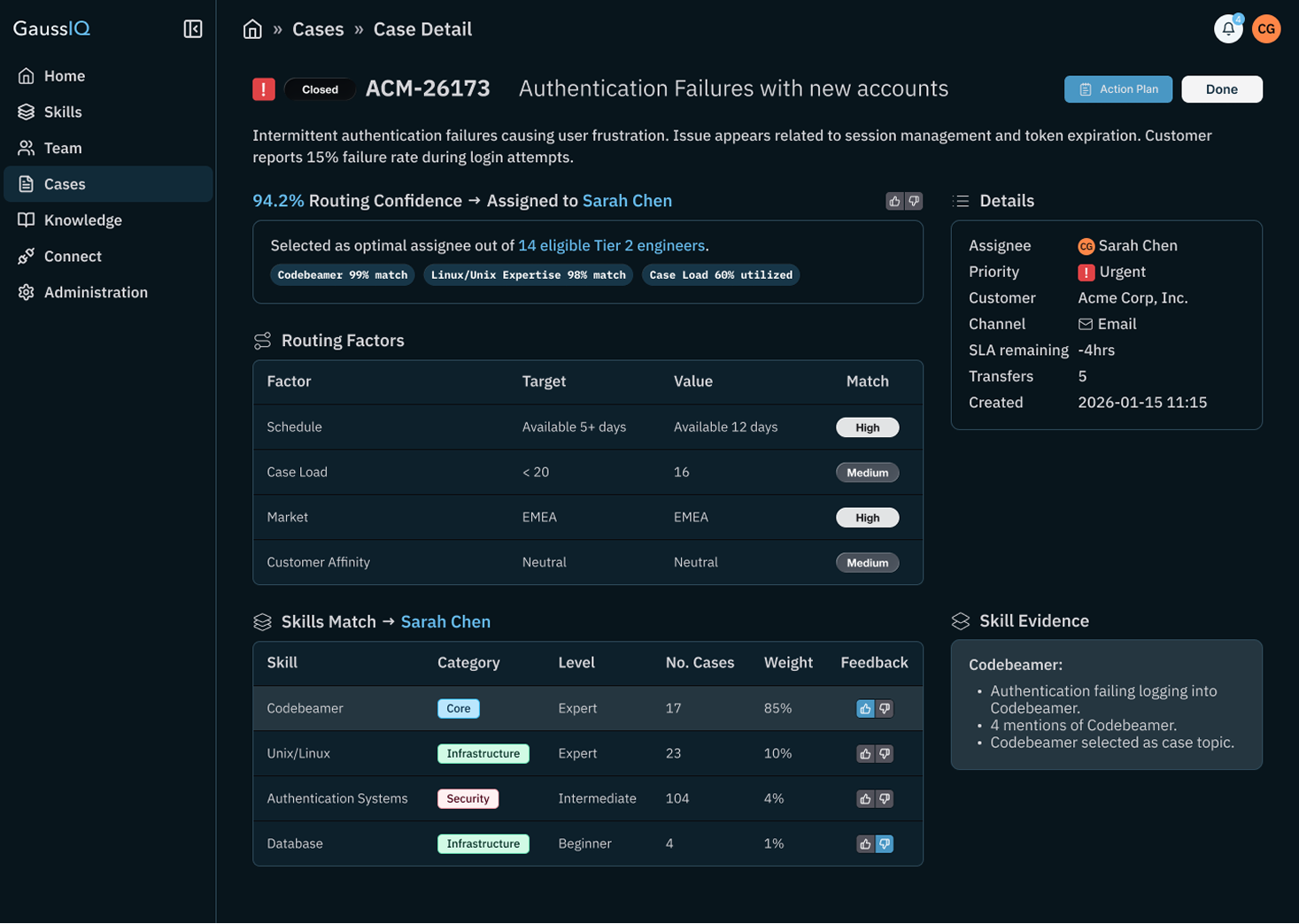
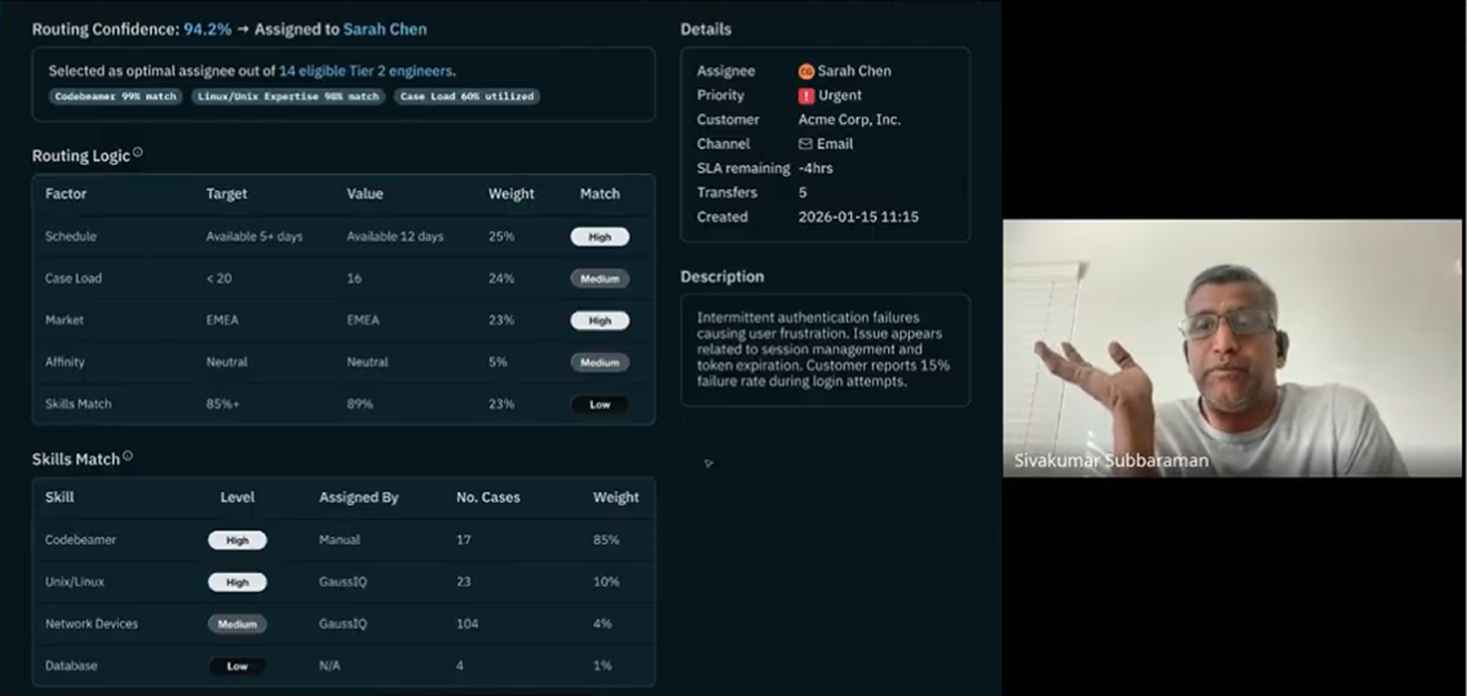
To address this, I designed interfaces that exposed the reasoning behind routing recommendations through:
Skill match evidence
Related case patterns
Confidence indicators
Feedback mechanisms for correcting errors
The goal was to make AI-assisted routing feel transparent, collaborative, and continuously improvable rather than opaque or automated without oversight.
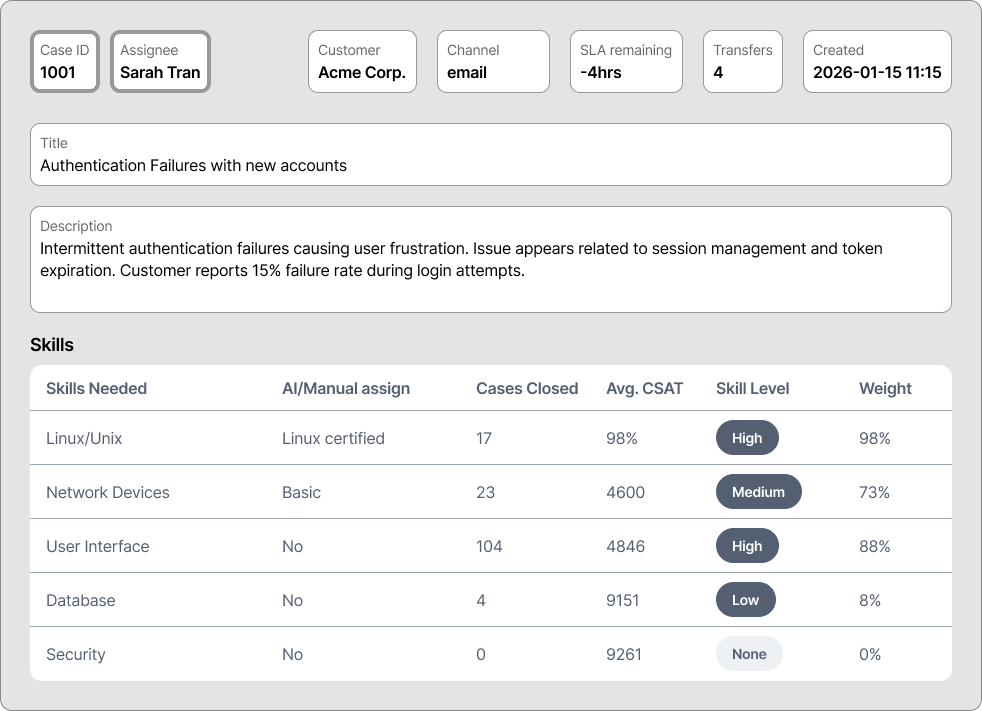
GaussIQ Case Detail screen showing routing logic
Skills Intelligence
A major focus of the product was creating a system capable of continuously understanding organizational expertise as it evolved over time.
This required designing workflows that supported:
Identifying emerging skills
Validating expertise
Managing approval processes
Understanding skill coverage across teams
Rather than relying on static spreadsheets, the system treated skills as living operational data that could evolve alongside the organization itself.
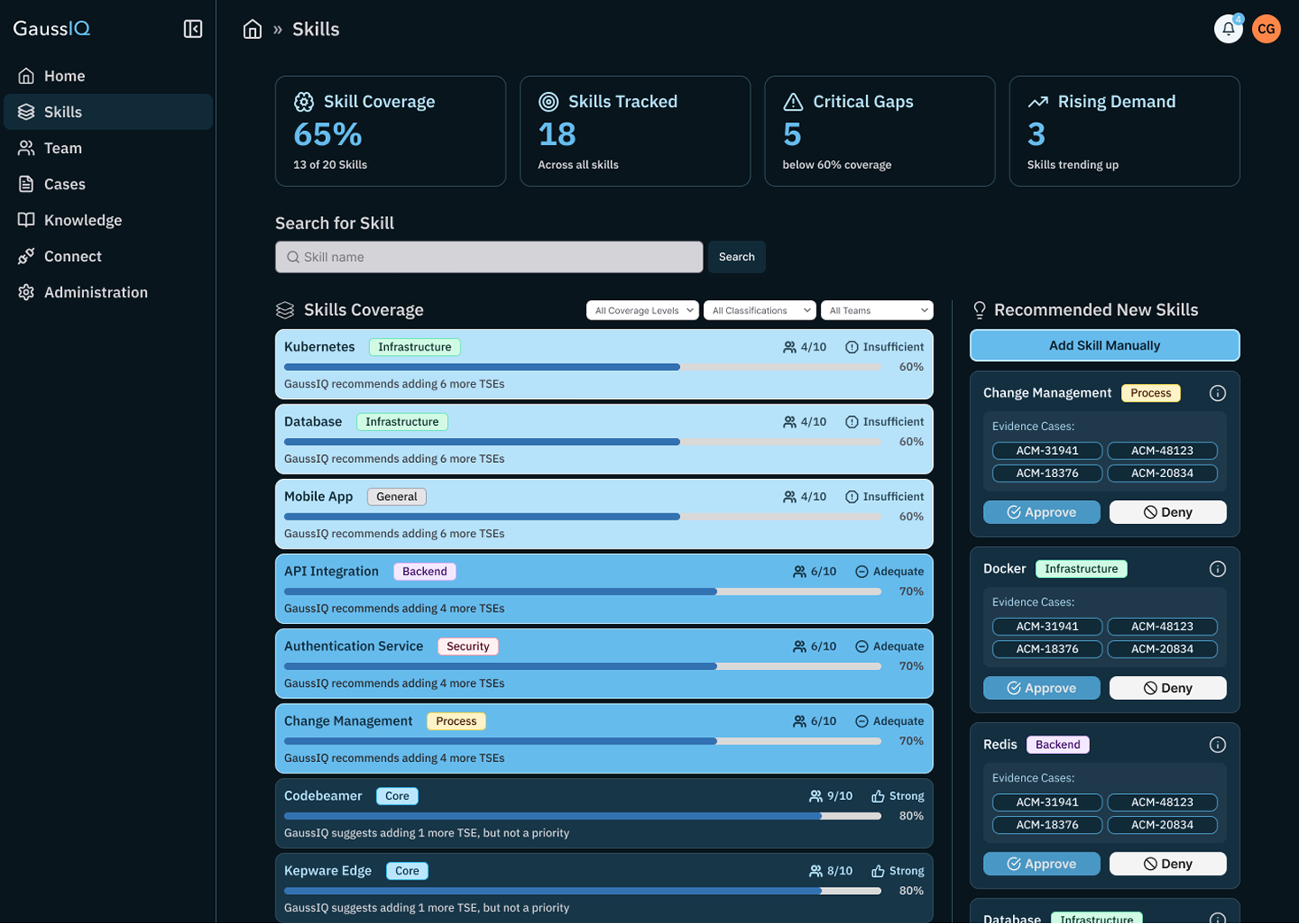
These explorations led to interfaces for:
Skill discovery and approval
Coverage visualization
Organizational expertise mapping
Skill-based routing configuration
GaussIQ screen for tracking team skills coverage
Design Systems & Scalability
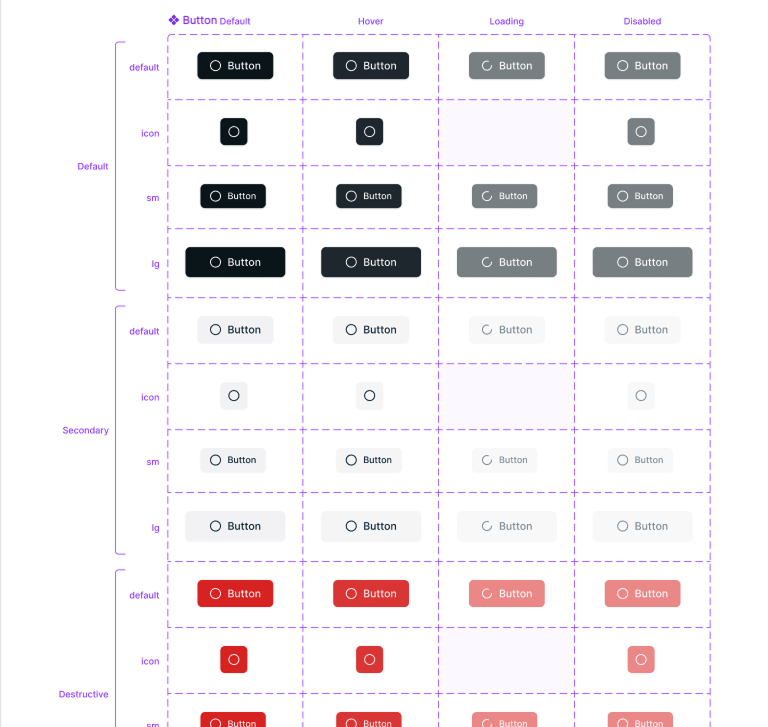
As the product matured, I also established foundational UI patterns and reusable components to support consistency and scalability across the platform.
This included:
Shared table and data visualization patterns
Status and signal systems
Reusable operational cards and layouts
Consistent interaction patterns for complex workflows
Given the density and complexity of the product, maintaining clarity and consistency became a critical part of the overall user experience.
By the end of this phase, I had evolved the product direction from a routing tool into a broader operational intelligence platform centered around skills, explainability, and organizational visibility.
Validate
Refining Through Feedback
Because GaussIQ was an early-stage product, validation focused less on polished usability testing and more on continuously refining the product direction through stakeholder feedback, operational discussions, and iterative design reviews.
Throughout the project, I worked closely with leadership stakeholders, engineering, and support organizations to evaluate whether the system was solving the right problems in the right way.
Several themes consistently shaped the evolution of the product.
Building Trust in the System
One of the most important areas of feedback centered around trust.
Stakeholders responded positively to the idea of AI-assisted routing, but concerns quickly emerged around explainability and confidence. Teams needed to understand why routing decisions were being made before they could rely on them operationally.
This feedback reinforced the importance of:
Transparent routing evidence
Confidence indicators
Human review and correction workflows
Feedback loops for improving routing quality over time
Live validation session with Siva - Director of Tier 3 support at PTC, a GaussIQ design partner
Reducing Noise
Another recurring challenge was balancing operational visibility with information overload.
Early concepts surfaced large amounts of system data, but stakeholder conversations revealed that leaders were already overwhelmed by dashboards and reporting tools.
This led me to further refine:
Signal prioritization
Action-oriented insights
Recommendation systems
Surfacing only the most operationally meaningful changes
I evolved the product toward a more focused and proactive operational experience rather than a passive monitoring tool.
GaussIQ landing page - post validation
Evolving the Skills Model
The concept of skills intelligence also evolved significantly throughout the design process.
Early discussions treated skills as relatively static organizational attributes, but ongoing conversations revealed how fluid expertise actually was in practice.
As a result, the system evolved to better support:
Emerging expertise
Skill validation workflows
Continuous refinement of organizational knowledge
Cross-functional visibility into skill coverage gaps
This feedback helped reinforce the idea that skills needed to function as a living system rather than a manually maintained reference document.
These iterations helped refine both the product direction and the operational philosophy behind the platform: improving routing was ultimately less about automation alone, and more about creating systems that organizations could understand, trust, and continuously improve over time.
Outcome
Impact & Reflection
The work at GaussIQ helped establish the foundation for a skills-driven operational intelligence platform centered around routing transparency, organizational visibility, and continuously evolving expertise.
Over the course of the project, the product direction evolved from a routing tool into a broader operational system designed to help support organizations better understand how work moved through their teams and where breakdowns were occurring.
Several core concepts became foundational to the platform:
Skills-based routing
Explainable AI-assisted recommendations
Operational signal prioritization
Continuous skill discovery and validation
Action-oriented operational visibility
As the founding designer, I helped shape not only the interface design, but the broader product direction and system thinking behind the platform. This included translating early concepts and technical ideas into workflows, interaction models, and operational experiences that could be understood and trusted by real organizations.
My biggest lesson: designing AI-assisted systems is often less about automation itself and more about trust, transparency, and adaptability.
Improving routing accuracy alone was not enough. Organizations also needed visibility into why decisions were being made, confidence that the system could evolve alongside changing expertise, and workflows that allowed humans to remain active participants in the process.
The project also reinforced the importance of designing operational tools as connected systems rather than isolated features. Routing, skills intelligence, organizational visibility, and feedback loops all influenced one another and needed to work together cohesively.
Working on GaussIQ deepened my experience designing for ambiguity, complex operational environments, and AI-assisted workflows—while balancing technical complexity with clarity, usability, and organizational trust.